Direct Answer: LED headlight flickering while the car is running is typically caused by alternator voltage ripple, a CANbus resistance mismatch, or a loose ground connection that only shows up once the engine’s charging system kicks in. Testing voltage stability at idle and adding a CANbus anti-flicker module usually resolves it.
Introduction
If your headlights look fine with the key just turned to accessory but start pulsing the moment the engine actually fires up, you’re dealing with a very specific version of led headlight flickering, one tied directly to your charging system. Drivers often ask why do my led headlights flicker when car is running but not before, and the answer almost always comes down to what changes the instant the alternator takes over: voltage output shifts, RPM fluctuates, and any weak point in the circuit gets exposed. This version of the aftermarket led headlights flickering problem is trickier to diagnose than a simple loose bulb, because it only appears under live electrical load, not with a multimeter check on a dead system.
Why does this problem happen?
When flicker only shows up with the engine running, the root causes shift toward the charging and load side of the circuit rather than the bulb itself:
- Alternator voltage ripple. As the alternator spins up, it produces small AC ripple on top of the DC output. LEDs are far more sensitive to this ripple than halogen bulbs, which simply absorb it as heat.
- RPM-dependent voltage swings. Voltage output rises and falls slightly with engine RPM, and a marginal LED driver can’t smooth that out, causing visible flicker specifically at idle or during acceleration.
- CANbus resistance mismatch under load. The car’s onboard computer monitors bulb resistance continuously while the engine runs, and LEDs drawing less current than expected can trigger repeated micro-interruptions.
- Loose or corroded ground strap. A ground connection that seems fine with the key off can fail intermittently once engine vibration and electrical load are added to the mix.
- Serpentine belt or alternator wear. A worn belt or a failing alternator diode can introduce electrical noise that gets picked up by sensitive LED drivers, especially at idle.
- Underrated LED driver. Budget kits with drivers not built to handle real-world voltage swings will flicker under load even though they test fine on a bench.
What early warning signs appear before full failure?
This engine-running version of flicker tends to build gradually before it becomes constant:
- Flicker that appears only at idle, then smooths out once you rev past 1,500 RPM.
- Headlights that pulse in sync with the AC compressor or wipers cycling on.
- A faint hum or buzz audible near the headlight housing when the flicker occurs.
- Dashboard battery or charging warning lights flickering at the same time as the headlights.
- One side flickering more than the other, suggesting an isolated ground or connector fault rather than a system-wide alternator issue.

How to diagnose and fix this problem step-by-step?
Tools Needed:
- Multimeter (with AC ripple testing capability if available)
- CANbus anti-flicker module matched to bulb wattage
- Electrical contact cleaner and microfiber cloth
- Dielectric grease
- Basic hand tools for headlight housing access
Chronological Fix Guide:
- Confirm the flicker is engine-dependent. Turn the key to accessory only (engine off) and check if flicker appears. If it only shows with the engine running, you’re dealing with a charging-system-related cause, not a simple loose bulb.
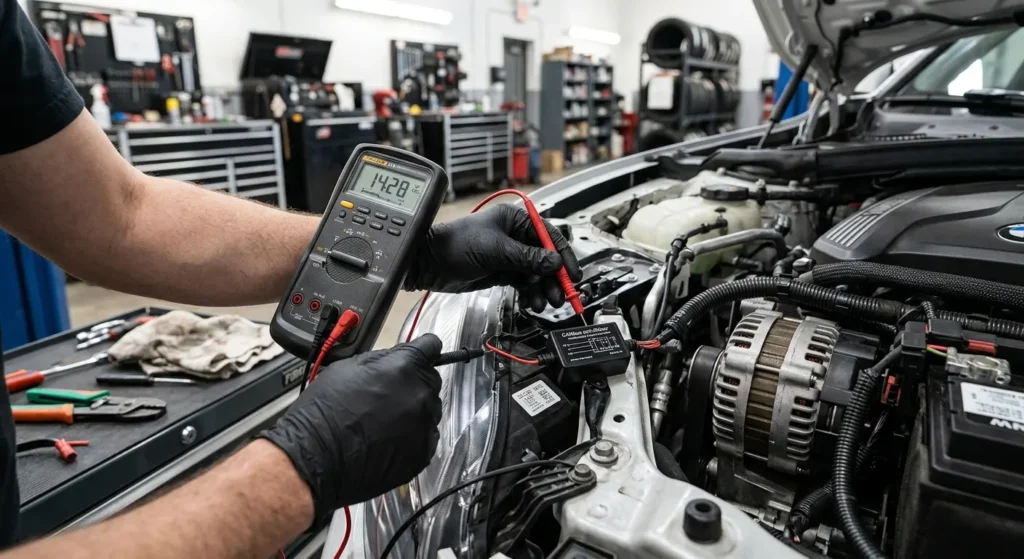
- Test voltage at idle vs. higher RPM. With a multimeter on the battery terminals, note the voltage at idle, then again at 2,000 RPM. A swing greater than 0.5V beyond normal alternator regulation suggests ripple or a failing diode.
- Inspect the ground connection under load. With the engine running, gently wiggle the LED kit’s ground wire at its chassis point. If the flicker changes, that’s your answer, how to fix flickering led headlights in this case means cleaning and re-securing that ground.
- Clean and reseat all connectors. Corrosion or a marginal connection that holds steady at rest can fail once engine vibration is added. Clean with contact cleaner and apply dielectric grease.
- Install or upgrade the CANbus anti-flicker module. This is often the fastest fix for how to stop led headlights from flickering under load, since it stabilizes the resistance signal the car’s computer is monitoring.
- Check the alternator and belt. If voltage ripple is confirmed and connectors check out fine, have the alternator’s diode output tested at a parts store, most offer this free.
- Retest across a full drive cycle. Confirm the led headlight flicker fix holds at idle, at speed, and with accessories like AC and wipers running simultaneously.
Expert’s Note: Real-World Testing & Diagnostic Insight
A regular customer brought in a truck with headlights that looked perfect in the driveway but flickered noticeably every time it idled at a stoplight. We ruled out the bulb and connector quickly since both tested clean, so we moved to the alternator. A quick diode test at idle showed voltage ripple outside normal range, a classic sign of a failing alternator diode. Once we swapped the alternator, the flicker disappeared completely, even at idle with the AC running. The lesson: if your led headlight flickering problem only shows up with the engine on, don’t stop at the bulb, check the charging system before assuming the LEDs themselves are defective.
How to prevent this issue from happening again?
- Have your alternator tested annually, especially past 60,000 miles, since diode wear is a slow, gradual process.
- Use a quality CANbus module from installation day, rather than waiting for flicker to appear before addressing it.
- Keep ground connections clean and tight, checking them every oil change if you drive in salt or heavy road grime conditions.
- Avoid stacking too many accessories on the same circuit as your LED headlights, since added draw increases voltage instability.
- Protect connectors from moisture by using dielectric grease and ensuring housing seals stay intact after any bulb service.
- Choose LED kits with a solid driver reputation, since a well-built driver smooths out voltage ripple far better than a budget one.
FAQ
Why do my LED headlights flicker when the car is running but not when it’s off? This points to the charging system, since voltage ripple and RPM-dependent fluctuations only exist once the alternator is active. Testing voltage at idle versus higher RPM will confirm whether ripple is the cause. A CANbus module or alternator repair typically resolves it.
How do I fix flickering LED headlights caused by the alternator? Start by testing voltage output at idle and at higher RPM to confirm ripple is present. If confirmed, have the alternator’s diodes tested, since a failing diode is the most common alternator-related cause. Replacing the alternator or adding a stabilizing module usually clears the flicker completely.
Do I need an anti-flicker module even if my headlights only flicker occasionally? Yes, occasional flicker often signals a marginal CANbus mismatch that will worsen over time as connectors age. Installing an anti flicker module for led headlights early prevents the issue from becoming a constant strobe later. It’s a low-cost fix compared to diagnosing a worsening problem down the road.
Conclusion
LED headlight flickering that only shows up with the engine running points toward your charging system, not just the bulb itself. Test your voltage under load, secure your grounds, and install a proper CANbus module, and you’ll get consistent, flicker-free lighting no matter what RPM you’re at. A focused diagnostic pass now means safer, distraction-free visibility on every drive.